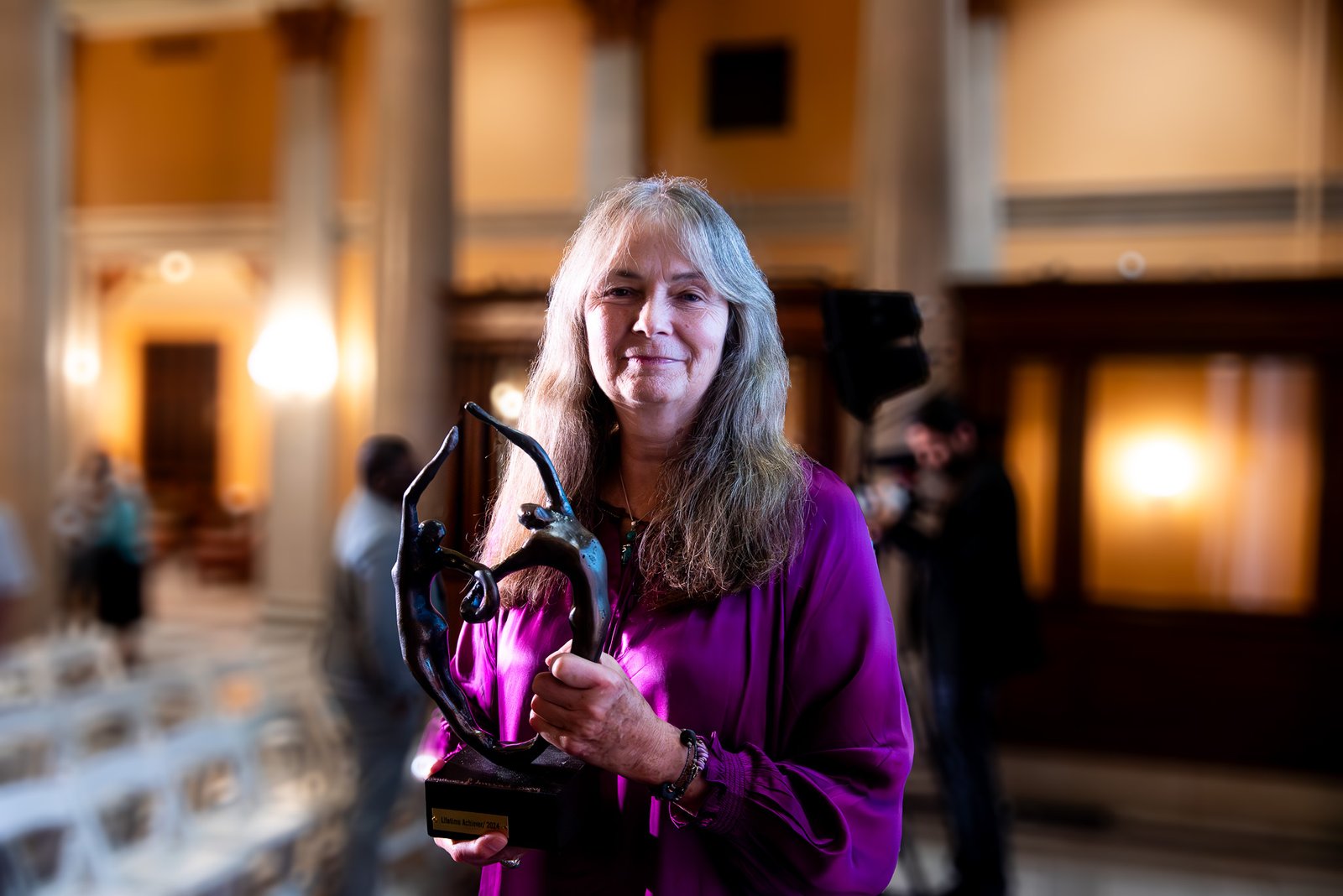
Jo Berry – Founder
Peacebuilder, Bridge-builder and Dialogue Facilitator
Jo Berry CBE is an international peacebuilder, speaker and dialogue facilitator who has spent more than 25 years exploring how we can transform conflict through empathy, deep listening and recognising our shared humanity.
She founded Building Bridges for Peace to inspire people to move beyond blame and dehumanisation, engage in courageous conversations and discover their own capacity to become positive changemakers.
Jo’s work is rooted in an extraordinary personal journey following the death of her father, Sir Anthony Berry MP, in the 1984 Brighton bombing.
Her decision to seek understanding rather than revenge eventually led to an ongoing dialogue with Patrick Magee, the former IRA volunteer responsible for planting the bomb. Their relationship, now spanning 26 years, has developed into a friendship and a shared commitment to peace.
But Jo’s work reaches far beyond this remarkable relationship.
She has delivered more than 1,000 talks and workshops in over 20 countries, working with schools, universities, communities, organisations and leaders. Drawing on lived experience, she creates spaces where people can explore difficult questions, challenge assumptions and find new ways of responding to conflict.
Her work includes peace education, conflict transformation, compassionate leadership, restorative approaches and helping people navigate difficult conversations without blame.
In 2025, Jo was awarded a CBE for services to peace and reconciliation.
My Journey
On 12 October 1984, my father, Sir Anthony Berry, was killed alongside four others in the IRA bombing of the Grand Hotel in Brighton.
I was 27 years old, and his death changed my life.
Two days later, I made a commitment to bring something positive out of what had happened and to try to understand those responsible.
I did not know where that commitment would lead me.
Over the following years, I began to explore the roots of violence and what happens when we see others as enemies rather than human beings.
In November 2000, I met Patrick Magee for the first time in Dublin.
I wasn’t looking for an apology or asking for forgiveness. I wanted to understand his story and discover whether I could meet him as a human being rather than as the person responsible for killing my father.
That first conversation lasted three hours. There were difficult moments, but also moments of unexpected vulnerability and connection.
Something shifted between us, and a journey began that neither of us could have predicted.
Over the past 26 years, Pat and I have shared our dialogue publicly hundreds of times. We have faced difficult questions, challenged one another and continued to learn. Our relationship has developed into friendship, without diminishing the reality of what happened.
It has taught me that empathy is not about agreeing with or excusing another person’s actions. It is about recognising their humanity, even when we profoundly disagree.
Taking the Learning into the World
The dialogue with Pat has been an extraordinary teacher, but I have always wanted to take the learning beyond our own story.
Through Building Bridges for Peace, I work with young people, communities and organisations to explore how we can respond differently to conflict.
I am particularly passionate about challenging dehumanisation and helping people recognise how easily we can turn others into enemies when we stop listening and become certain that we are right.
I believe we can challenge without blaming, understand without agreeing, and find the courage to stay open even when conversations are difficult.
My work is not about telling people what to think. It is about creating opportunities for people to discover something for themselves.
I have seen young people begin to recognise their own power to make a difference, communities find hope across deep divisions, and individuals discover new ways of relating to those they disagree with.
These experiences continue to inspire me.
Unbounded Empathy
One of the most important lessons of my journey is that empathy does not have to be limited to one side.
We can recognise the suffering and humanity of people across a conflict without justifying violence or abandoning accountability.
I call this unbounded empathy.
It asks us to move beyond the labels and stories that divide us, and to remain curious about the human being in front of us.
I know how difficult this can be. I also know how transformative it can be.
I do not believe peacebuilding means having all the answers. It means being willing to listen, to be vulnerable, to question our assumptions and to create the conditions where something new can become possible.
Continuing the Journey
My work continues to evolve.
Through talks, workshops, community dialogue and screenings of the documentary The Hardest Bridge, I am committed to bringing people together across differences and inspiring positive change.
I believe that even in a deeply divided world, we can choose how we respond to one another.
Every one of us has the capacity to build a bridge. And every bridge begins with a willingness to see the humanity in another person.

Looking back on the years which have passed since the bomb, I am so touched by the amazing people I have met and the opportunities I have had to make a difference. I have now shared a platform with Pat Magee over 300 times and I see how our dialogue has inspired others to choose a non-violent solution. I have learnt so much from this challenging dialogue and continue to do so. I have learnt about my capacity for violence and for non-violence. I am learning to give up blame and choose empathy.
I passionately believe that there is humanity in everyone, and every time we demonise the “other” we are delaying the onset of peace in this world. Once we find our own humanity, and we see the humanity in the other, then we are going to want them to have their human rights, their good housing, food, medicine, education and freedom to be themselves, to be safe and secure. We will want for them all what we want for ourselves. Peace happens when we treasure everyone, all creatures, our land, our planet, and work together to find solutions in which everyone wins.
We have been speaking in many different places including Lebanon, Rwanda and Israel and Palestine. We have been all over Europe and in the UK we have spoken in schools, Universities, religious groups, youth groups and many organisations.
I am now focused on working with young people and and empowering them to be positive changemakers.